Intro to the Attachment Guide
Start here
Video Transcript
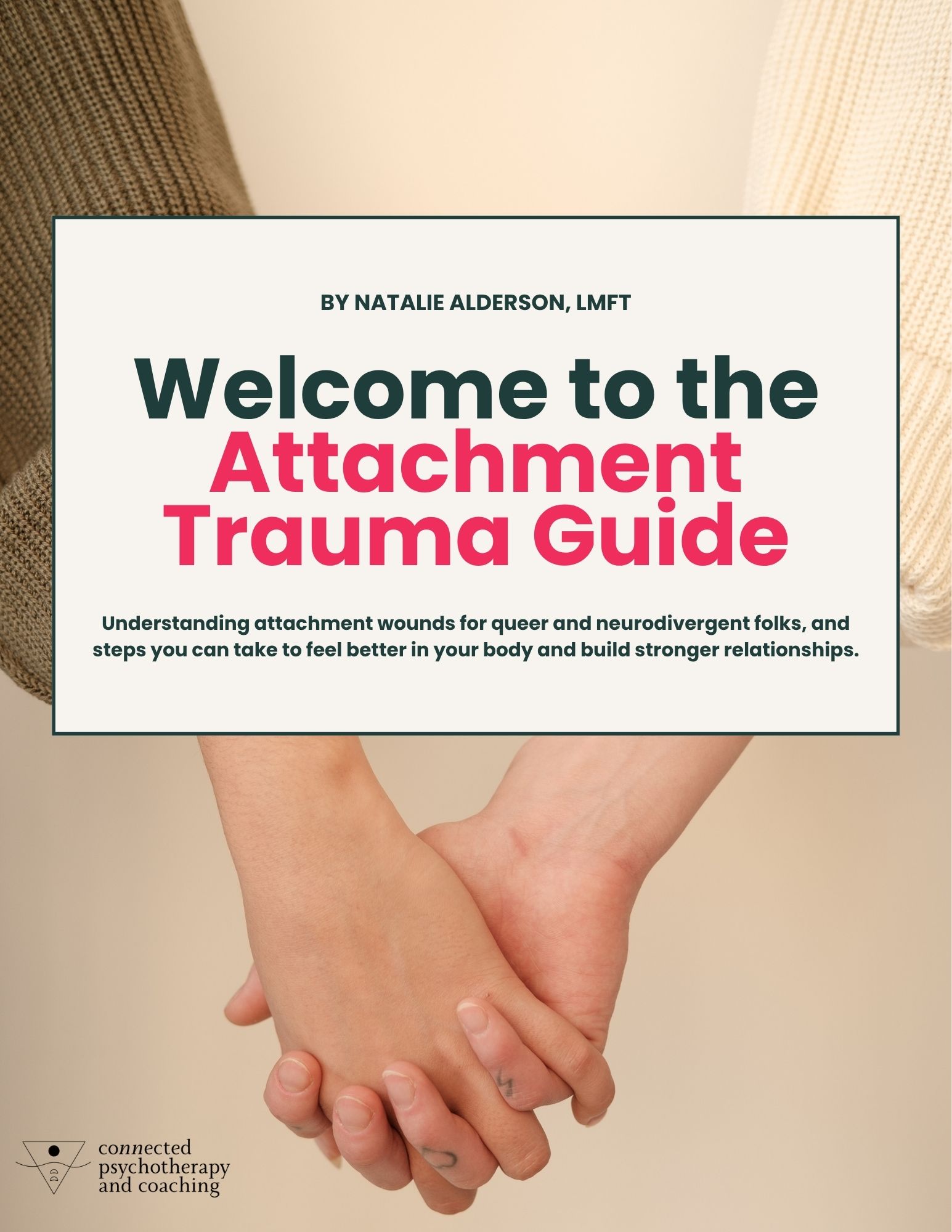
Natalie (00:00)Hi, and welcome to the Attachment Trauma Guide. My name is Natalie. I'm a licensed somatic therapist and somatic coach, and I specialize in working with queer and neurodivergent folks who are healing from trauma and codependency-related struggles. This guide is designed to help you understand attachment wounds for queer and neurodivergent folks and steps you can take to feel better in your body and to build stronger relationships.
Natalie (00:22)
Now, this guide was designed to be very simple. So whether you are someone who's maybe read a book on attachment or worked with a therapist who specializes in attachment, or if attachment information is brand new to you, this guide's designed to bring you back to the basics and make the information very simple and accessible and the tools to help you shift your relationship with attachment to also be very simple and accessible.
Natalie (00:47)
Because I find that those things are really helpful for folks to get consistent with the information and with the practices. And that consistency is gonna be the thing that really starts to shift things for you. So this guide is divided into five sections. The first one is the basics of attachment and trauma. The second one is the attachment styles themselves. The third is a fresh perspective, things that I've noticed in my work in the last nine years as a therapist and the last five years as a coach.
Natalie (01:15)
And the queer neurodivergent experience of trauma, because that often comes with not only a family of origin attachment wound, but also a cultural attachment wound. And then the last two sections are what you can do with this information, and that's divided into your relationship with yourself and your relationship with other people. And so what I've noticed in my time working with folks in this way.
Natalie (01:41)
Is that a lot of times we are looking for safety through certainty, and life in relationships are inherently uncertain. And so the somatic practices and the exploration prompts in this guide are really designed to help you feel a sensation of having your own back and how to bring that sensation into your relationship so that you can start to earn and practice a secure attachment. And
Natalie (02:09)
This guide is going to have a bunch of information at the beginning of it. And then the last part of it will have exploration prompts, somatic practices. And what I really encourage and invite for you is to get consistent with all of those things. So what I mean when I say consistent with the information is that taking that information and noticing how it shows up for you as a unique person, brain, body with your own circumstances and all of those things.
Natalie (02:36)
So as you're learning the information, going into your relationships and noticing how is this showing up for me? In what relationships is this showing up for me? What does it feel like in my body when I'm experiencing something like anxious attachment? And really starting to put that information into your unique life. And then with the somatic practices and the exploration prompts, it's really about getting consistent, whatever consistency means for you.
Natalie (03:03)
That could be every day, that could be once a week, that could be twice a month. It really depends, but your nervous system really likes consistency when it comes to these things. And so when we're talking about feeling better in your own body and building stronger relationships, what we need is that consistent practice. And with the aspect of relationships to other people, that part of the guide is really looking at the rupture and repair cycle.
Natalie (03:29)
Which means what happens when somebody hurts you or you hurt someone in relationship? And how do you navigate repairing that? Because what happens on the other side of that repair is a deeper relationship. And all of that is for relationships where repair is appropriate, assuming that it's a healthy enough relationship where you want repair and you want to continue that relationship. Because that's how we build trust when we are able to navigate challenges together.
Natalie (03:55)
And know that we can come out the other side of that and still have a deep and meaningful relationship. So I hope this guide feels supportive to you. I hope that it helps you kind of shift some things in terms of how you're experiencing your own attachment wounds. And I just thank you so much and am so grateful that you are here trusting me to learn this information from and to learn this information with. So thank you and I hope it serves you in all of the ways that you're hoping it will.